


Written by: Rameez Makhdoomi
( The writer is an eminent freelance journalist of Jammu and Kashmir).
Autumn in Kashmir is not merely a climatic interlude; it is a cultural reckoning, a seasonal philosophy, and a quiet archive of centuries-old labour. It is the time when the year’s exertions-spread across orchards, fields, mountainsides, and the invisible corridors of human endurance-are finally audited by nature. The farmer’s sweat, the orchardist’s vigilance, the shepherd’s long march, and the cultivator’s intimate dialogue with soil all arrive at their annual moment of truth.
Nowhere does this reckoning unfold with greater splendour than in the Kashmir Valley, where autumn assumes a distinct grammar: austere yet extravagant, melancholic yet restorative, transient yet unforgettable.
The Harvest of a People’s Perseverance
In Kashmir, autumn is inseparable from the harvest of apples and rice—two lifelines that sustain households, economies, and entire social structures. This is the season when the world-famous apple-the pride of Kashmiri horticulture-begins its final journey from orchard to market. Each crate is not merely produced; it is the consolidation of a year’s anxieties, hopes, and relentless toil.
Likewise, the rice fields, which begin as fragile green shoots in early summer, stand ready in autumn as mature, golden crops-embles of tenacity and continuity. Side by side come the walnuts and almonds, their hard shells hiding the subtle richness that has fed generations.
Autumn, therefore, is the farmer’s ledger, where every failure, every pest attack, every storm survived, and every gamble taken in spring and summer is accounted for.
A Season That Shapes Thought
Kashmir’s autumn has long captivated poets, philosophers, and thinkers, not because of its spectacle alone, but because it acts as a metaphor for introspection and impermanence. Across history, writers have turned to this season to contemplate the burdens of memory, the inevitability of change, and the quiet art of survival.
In Kashmir, this contemplative urge intensifies. The valley’s landscapes in autumn-neither fully alive like summer nor entirely dormant like winter-create a liminal space where ideas germinate and inner voices become sharper. It is the season when thought sheds its excesses, much like trees shedding their leaves.
The Reign of the Chinar
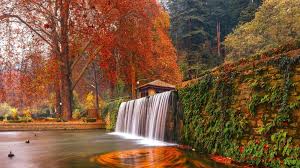
Nothing embodies the Kashmiri autumn more profoundly than the majestic Chinar. When its giant leaves turn copper, crimson, and burnt gold, the valley acquires a mystic texture unmatched anywhere else. As these leaves fall, they carpet the earth with a layer that is both elegiac and enchanting-a silent testimony to the passage of time.
Walking through a Chinar grove in autumn is akin to stepping into a living manuscript. Every rustle underfoot carries a whisper of history, every falling leaf a reminder that beauty and decay often travel together. The air thickens with a smoky fragrance as leaves are raked into small mounds and lit, allowing a familiar warmth to drift through neighbourhoods and memories alike.
Lessons in Adaptation and Renewal
Autumn in Kashmir is not only an aesthetic experience; it is a philosophical lesson. As trees shed their leaves, they demonstrate the discipline of letting g-discarding the non-essential to conserve strength for the harsher days ahead.
There is a wisdom here that extends far beyond botany:
- To mend is not to erase the past but to refine it.
- To embrace change is not weakness but foresight.
- To prepare for the future requires clarity, restraint, and resilience.
- Nature rehearses these principles every year. It is we who forget them.
Understanding the Season’s Deeper Contours
The very word autumn carries layers of meaning inherited from ancient languages: connotations of passing time, cooling air, and drying earth. Historically, “harvest” itself was the name of this season-until urban life severed the link between time and labour, and the season acquired new linguistic clothing.
But in Kashmir, the older understanding survives. Here, autumn is still harud-the season of gathering what has been sown, of evaluating one’s year, of reconciling with both abundance and loss.
A Serenity Carved in Light and Silence
As the valley shifts from the bright greens of summer to the burnished palette of autumn, Kashmir acquires an atmosphere that borders on the surreal. The light becomes softer, the evenings quieter, and the scenery sharper in detail. There is a serenity to this season that refuses exaggeration; it must be felt, not narrated.
The beauty of autumn in Kashmir lies not only in the spectacle of falling leaves or the fragrance of ripe orchards, but in its unspoken depth-a depth that tugs at memory, imagination, and the human condition itself.
More Than a Season
Ultimately, autumn in Kashmir is a mood, a memory, and a measure of endurance. It is the valley’s way of reminding its people that every cycle of loss conceals a seed of renewal, that every fading colour prepares the ground for a future bloom, and that even the most delicate beauty carries an undercurrent of strength.
To witness autumn in Kashmir is to experience the valley in its most truthful form-unadorned, introspective, and quietly magnificent.